Free Yoga Studio Software vs Paid: Is It Worth It? (2026)
Free yoga studio software is worth it if you're a solo yoga teacher with a small group of regular students (roughly under 25–30) who mainly needs a class timetable and online booking. Once you're selling class packs or memberships, matching UPI payments, chasing renewals or adding a second teacher, a paid or low-cost yoga booking system usually pays for itself in time saved. Judge software by the hours it saves you each week, not just its monthly price.

Most independent yoga teachers in India start the same way. Bookings come in on WhatsApp, payments arrive as UPI screenshots, and attendance lives in a notebook or a Google Sheet. It works, until your batches fill up and the admin starts eating into your evenings. That's usually when teachers start searching for free yoga studio software or a cheap yoga booking system.
Free vs Paid Yoga Booking Systems: Is Free Yoga Studio Software Worth It?
The appeal is obvious: why pay for software when free tools exist? The more useful question is whether free software is actually saving your yoga business money, or quietly costing you time. This guide compares free and paid yoga booking systems honestly, so you can decide what fits your practice today and what you'll need as it grows.
In short: Free yoga studio software is worth it if you're a solo yoga teacher with a small group of regular students (roughly under 25–30) who mainly needs a class timetable and online booking. Once you're selling class packs or memberships, matching UPI payments, chasing renewals or adding a second teacher, a paid or low-cost yoga booking system usually pays for itself in time saved. Judge software by the hours it saves you each week, not just its monthly price.
What Is Yoga Studio Software?
Yoga studio software is a digital system that helps yoga teachers and studio owners run the business side of their classes. Depending on the platform, it can include:
• Class scheduling and online booking
• Student records and attendance
• Class packs, memberships and payments
• Reminders and student communication
• Progress tracking and reports
• Nutrition and wellness support
• Branding, such as your own booking page or student app
Not every yoga business needs all of this from day one. A solo teacher with 15 students has very different needs from a studio with 200 students and five instructors. So the right question isn't simply "free or paid?" It's "What does my yoga business actually need right now?"
Why Do Yoga Teachers Choose Free Software?
When you're starting out, every monthly expense matters. Free yoga studio software lets you move bookings off WhatsApp without adding another bill. It makes sense if you:
• Teach solo, with a small student base
• Run only a few batches a week
• Mainly need students to see your timetable and book a spot
• Are still testing your classes, timings and pricing
• Don't yet need packs, memberships or advanced tools
For example, if 15 students attend three batches a week, a simple free booking tool may be all you need. You don't need a complex platform just because you run a yoga business. Start with what you need, but understand what happens when you grow.
What Can Free Yoga Booking Software Actually Do?
Most free plans cover the basics well:
Class scheduling. Publish your timetable so students always know when sessions run.
Online booking. Students reserve a spot through a link instead of messaging you every time.
Basic student records. Names, contact details and booking history in one place.
Attendance. Some free tools let you mark who came to each class.
Free options come in two types. Some yoga and fitness platforms offer a free plan with limits on students, classes or features. Others are general tools that teachers adapt for yoga, such as Google Forms or a free scheduling app like Calendly. Both can work for a small practice, but general tools weren't built for batches, class packs or attendance, so you'll fill those gaps by hand.
The Hidden Costs of "Free" Yoga Studio Software
Your software may be free. Your time isn't. Free plans can also carry costs that don't appear on the pricing page:
Limits that arrive as you grow. Free plans often cap students, bookings, classes or staff, and you tend to hit the cap just as your business starts working.
Payment fees. Free tools that take online payments usually charge a per-transaction fee, and some add a platform fee on top of the payment gateway's charges.
Someone else's branding. Your booking page may show the provider's logo or ads instead of yours.
Locked features. Reminders, packs with expiry dates and reports are often available only on paid plans.
Limited support. If something breaks before your Saturday morning batch, free plans rarely come with fast help.
Switching costs. If you can't export your student data easily, moving later means re-entering everything.
What your admin time is really worth
Think about a typical day: confirming bookings on WhatsApp, matching UPI screenshots to students, marking attendance, sending reminders, updating your sheet and checking whose pack is about to expire. Each task takes only a few minutes, but at 45 minutes a day, six days a week, that's about 4.5 hours a week, or roughly 18 hours a month.
If you value that time at what one more class would earn you, say ₹500 an hour, that's around ₹9,000 a month of your time spent on admin. Add one student whose ₹4,000 monthly pack lapses unnoticed each month, and that's another ₹48,000 a year in lost income. (These figures are illustrative. Plug in your own rates.)
So the real question isn't "How much does this software cost?" It's "How much time and income does it save me?" A system that halves your admin is worth far more than its subscription.
Free vs Paid Yoga Booking Systems: Side-by-Side Comparison
Here's how free and paid options typically compare for a yoga teacher in India:
|
Feature |
Free software (typical) |
Paid software (typical) |
|
Class scheduling |
Basic timetable |
Recurring batches, class capacity and waitlists |
|
Online booking |
Usually included |
Included, often on your own branded booking page |
|
Student records |
Basic contact details |
Full profiles with history and notes |
|
Attendance |
Manual or limited |
Linked automatically to bookings and packs |
|
Class packs and memberships |
Often missing or limited |
Packs, expiry dates and renewals tracked |
|
Payments (UPI, cards) |
Limited, extra fees possible |
Integrated payment tracking and invoices |
|
Reminders |
Few or none |
Automated booking and renewal reminders |
|
Reports |
Basic counts |
Revenue, attendance and retention trends |
|
Branding |
Provider's branding |
Your logo and colours, sometimes your own app |
|
Data export and support |
Often limited |
Data export and dedicated support |
|
Scalability |
Capped students or classes |
Built to grow with your business |
Features vary by provider, so always check the exact limits of any plan you're considering.
This doesn't mean paid software is automatically better. If you teach solo with 15 students, paying for dozens of features you'll never use doesn't make sense. The goal is the right balance of cost, features and room to grow.
When Is Free Yoga Studio Software Enough?
Free software is a sensible choice in the early stages of your yoga business:
You teach solo. You run your own classes with a small, regular group of students.
You're testing your offer. You're still working out your batches, timings and pricing.
You only need booking. Students mainly need to see your timetable and book a spot.
Your payments are simple. A handful of students pay you monthly by UPI, and that's easy to track.
In these situations, free software helps you look organised without adding a monthly expense.
When Does Free Software Start Holding You Back?
Now imagine your practice grows: 15 students → 40 students → 80 students, perhaps with a second teacher, an online batch or a weekend workshop. Your to-do list grows with it: more batches, packs and memberships, renewals, payment follow-ups, attendance, student progress and communication.
At this point, basic booking software solves only one part of the problem. And a cheap yoga booking system can become expensive in a different way, because you end up stitching tools together:
One booking tool + a Google Sheet for students + WhatsApp for reminders + UPI screenshots for payments.
Now you're managing tools instead of managing your business. Common signs you've outgrown free software:
• You've hit a student, booking or class limit on your plan
• You track pack expiry dates by hand
• You've missed a renewal or lost track of a payment
• Admin takes more than three or four hours a week
• You're adding a second teacher, an online batch or workshops
What Should You Look for in a Cheap Yoga Booking System?
Don't choose a platform just because it has the lowest monthly price. Ask these six questions first.
1. Can it manage all my students in one place?
Look for central student profiles that hold bookings, attendance and payments together, rather than records scattered across apps.
2. Does it handle class packs, memberships and expiry dates?
Most yoga teachers in India sell monthly batches or class packs. Your system should track remaining classes and expiry dates automatically.
3. Does it work with how my students pay?
In India, that usually means UPI. Check how payments are recorded, what fees apply and whether you can issue invoices, including GST invoices if you're registered.
4. Does it cut repetitive work?
Automated booking confirmations, class reminders and renewal reminders are where most of the time savings come from.
5. Can I export my data?
If you switch later, you should be able to take your student list and history with you.
6. Will it still work at 100 students?
Don't only ask "Does this work for me today?" Ask "Will it still work when I have 100 students, a second teacher or an online batch?"
Booking Is Only One Part of a Student's Yoga Journey
A student doesn't only book a yoga class. Their journey looks more like this:
Discover your classes → Book → Attend → Build a practice → Follow a wellness routine → Track progress → Stay with you
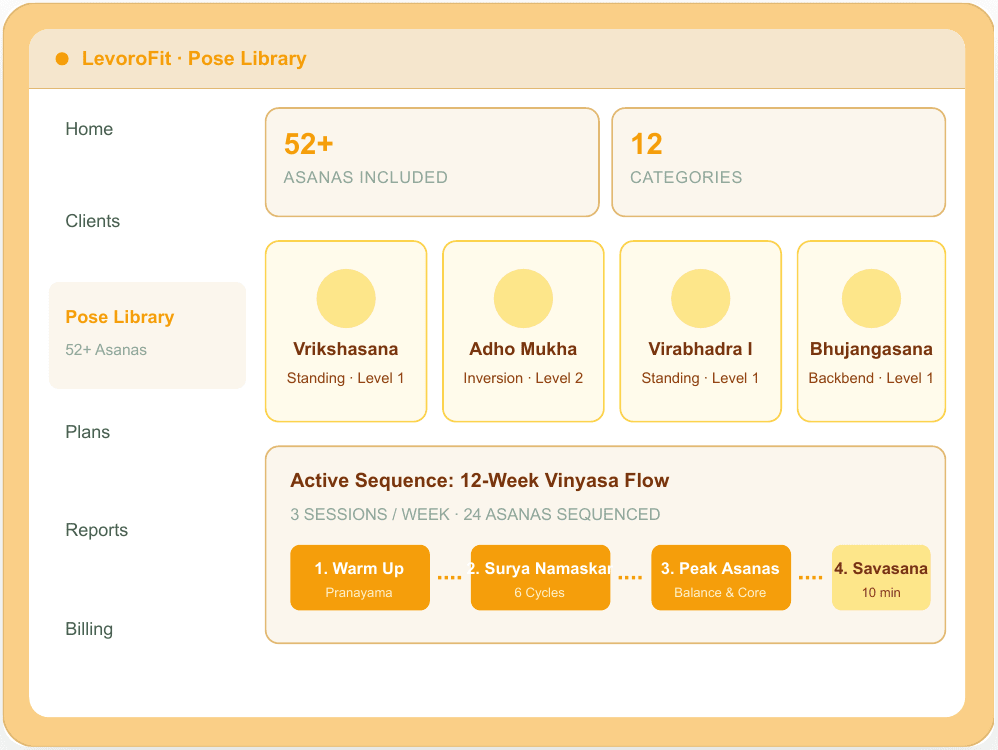
Basic booking software manages just one step of that journey. A more complete platform connects the rest. LevoroFit's yoga offering is designed around this broader approach, bringing classes, instructors, practitioner progress and personalised nutrition support together in one white-label platform.
That shifts the focus from "Who booked today's class?" to "How is each student progressing?"
Beyond booking: nutrition and wellness
Yoga often goes beyond the studio floor. For teachers who want to offer a more complete wellness experience, LevoroFit includes nutrition features such as Sattvic and yogic meal plans, energy-focused meal guidance for practice days, pre- and post-class nutrition suggestions, and integration with student wellness data. Practice, nutrition, progress and wellness then sit in one place instead of being managed separately.
White-label yoga software: your brand, not ours
Your yoga studio has its own name, logo, colours, community and teaching style. Your digital experience should feel like an extension of that brand.
LevoroFit's white-label option lets you use your own logo, colours and domain, along with a branded student mobile app, student portal, emails and notifications. Instead of sending students another company's booking link, you give them an experience that's clearly yours.
Where Does LevoroFit Fit?
For a new solo teacher with simple needs, a free booking tool may be enough, and that's a perfectly good place to start. LevoroFit is for yoga teachers and studios ready to go beyond basic scheduling. It combines studio management, client management, scheduling, personalised nutrition support and white-label branding in one platform. It also offers a 14-day free trial with no credit card required, so you can test it with your real batches before committing.
So the real choice isn't simply free vs paid. It's basic booking vs a connected system for running your yoga business and supporting your students.
So, Should You Choose Free or Paid?
There isn't one answer for every yoga business.
Choose free yoga studio software if:
• You're just starting out
• You have a small number of students
• You only need scheduling and booking
• Your payments are simple to track
Choose a paid or low-cost yoga booking system if:
• Your student base is growing
• You sell packs or memberships with expiry dates
• Admin is taking several hours a week
• You need reminders, payment tracking and reports
Choose an all-in-one platform if:
• You want studio management and wellness tools together
• You want to offer personalised nutrition support
• You want to track student progress
• You want a branded app and booking experience
• You want software that grows with your business
Final Thoughts: Is Free Yoga Studio Software Worth It?
For a solo teacher or small yoga business with simple needs, yes, free yoga studio software is a sensible starting point. But free isn't automatically better, and the cheapest yoga booking system isn't always the cheapest once you count your time.
Before choosing, ask yourself:
• How many students do I manage now, and how many do I expect in a year?
• How many hours a week do I spend on admin?
• Do I sell packs or memberships that need tracking?
• Do I want to track student progress or offer nutrition support?
• Will this software still work as my business grows?
The right software isn't the cheapest one, and it isn't the one with the longest feature list. It's the one that fits your business today and your plans for tomorrow.
Start simple. Grow smarter. Choose a platform that grows with your yoga business.
For the wider picture of running an independent practice, from pricing your classes to finding students, read our guide on how to run a successful solo yoga business in India. If you're ready to compare full platforms, see our comparison of 7 yoga studio platforms.
Ready to spend less time on admin and more time teaching?
Start your 14-day free trial → No credit card required.
Book a demo → See scheduling, packs and student management on a real workspace.
Explore LevoroFit's plans to find the setup that fits your practice.
Frequently Asked Questions
Is there free yoga studio software?
Yes. Several yoga and fitness booking platforms offer free plans, and many teachers use general free tools such as Google Forms or Calendly to take bookings. Free plans usually limit students, classes or features and may add payment fees, so check the limits before you commit.
Is free yoga booking software good for solo instructors?
Yes, for most solo instructors who are starting out. If you teach a small group and mainly need a timetable and online booking, a free tool is usually enough. Consider upgrading once you sell packs, track renewals or spend hours each week on admin.
What is a cheap yoga booking system?
A cheap yoga booking system is a low-cost platform that handles class scheduling and online bookings for yoga teachers. The best ones also track class packs, payments and attendance. Compare features, limits and fees, not just the monthly price.
How much does yoga studio software cost?
Costs range from free plans to monthly subscriptions that rise with the number of students, staff or features you need. For a solo teacher, the best test is to compare the monthly price with the admin hours it saves. A tool that saves 10 or more hours a month usually pays for itself.
Can I manage yoga bookings with WhatsApp and Google Sheets?
Yes, for a small batch, and many yoga teachers in India start this way. It gets hard to manage beyond about 25–30 students, especially once you have packs with expiry dates and UPI payments to match, because nothing updates automatically.
Do free yoga booking apps charge fees?
Often, yes. Free plans that accept online payments usually charge a per-transaction fee, sometimes on top of the payment gateway's own charges. Read the pricing page carefully before you start collecting payments through the app.
When should a yoga teacher move from free to paid software?
Move when admin takes several hours a week, when you hit your free plan's limits, or when you need packs, renewals, reminders or payment tracking. Adding a second teacher or an online batch is another common trigger.
Is LevoroFit suitable for solo yoga teachers and yoga studios?
Yes. LevoroFit offers yoga studio management features including classes, instructor management, practitioner progress, personalised nutrition support and white-label branding. It suits solo teachers and studios who want more than basic booking, and you can try it with a 14-day free trial, no credit card required.
⏳ Update History
Last edited by Blog Admin
"Updated via admin form"
Vinay Jindal
Fitness • Health & wellness • Nutrition
Vinay Jindal is a wellness content intern at Levorofit with a keen interest in healthcare technology, digital wellness, nutrition, and preventive health. He enjoys researching how emerging technologies like artificial intelligence are improving healthcare accessibility, patient engagement, and overall well-being. Through his writing, he aims to make complex health and technology topics easier for readers to understand. He enjoys exploring the latest developments in nutrition, fitness, recovery, healthy habits, and digital health to create informative content that empowers individuals to make smarter lifestyle choices. At LevoroFit, Prince contributes educational content that helps fitness professionals, nutrition coaches, and health-conscious individuals stay informed about evolving trends in health, wellness, and nutrition.