
How to Run a Solo Yoga Business in India: Best Tools (2026)
Most independent yoga teachers in India don't struggle because of their teaching. They struggle because, alongside teaching, they are also the receptionist, the marketer, the accountant and the person chasing UPI payments at 10 pm. A successful solo yoga business is one where those jobs are handled by simple systems, so your energy goes into classes and students.
How to Run a Successful Solo Yoga Business in India: Best Tools for Independent Teachers
Most independent yoga teachers in India don't struggle because of their teaching. They struggle because, alongside teaching, they are also the receptionist, the marketer, the accountant and the person chasing UPI payments at 10 pm. A successful solo yoga business is one where those jobs are handled by simple systems, so your energy goes into classes and students.
This guide walks through the six jobs every solo yoga business has to get right, from defining your offer to keeping students for years. For each one, we cover the practical approach and the best tools for independent teachers at that stage, including where software for independent yoga teachers genuinely helps and where a free tool is enough.
In short: to run a successful solo yoga business, define a clear niche, price your classes in packages rather than drop-ins, build a steady way for students to find you, deliver classes reliably in person and online, make payment effortless, and actively look after the students you already have. Free tools like WhatsApp Business, Instagram and Google Business Profile cover marketing well. Once you teach several classes a week, a yoga instructor platform such as Levorofit Yoga Studio Software brings bookings, payments, attendance and retention into one place so nothing slips.
The Six-Job Framework: What Running a Solo Yoga Business Involves
Every solo yoga business, whatever its size or style, runs on the same six jobs. We call this the Six-Job Framework. Students only see one of them, the class, but all six decide whether your practice grows or stalls.
1. Defining your offer: who you teach, what style, and in what format.
2. Pricing: how much you charge and how students pay over time.
3. Finding students: how new people discover and trust you.
4. Delivering classes: running sessions reliably, in person, online or both.
5. Getting paid: collecting money, tracking dues and staying compliant.
6. Keeping students: making sure people who start with you stay with you.
Most teachers start by doing all six by hand, using WhatsApp, a notebook or a Google Sheet, and UPI screenshots. That works for the first ten or fifteen students. Past that, small things start to slip: a renewal nobody reminded, a payment you can't match to a name, a regular who quietly stopped coming.
The rest of this guide takes each job in turn, with the approach that works and the tools that make it easier.
Step 1: How to Choose Your Yoga Niche and Offer
The most successful solo teachers are known for something specific. "Yoga classes in Pune" competes with hundreds of studios. "Gentle morning yoga for women over 50 in Kothrud" or "Prenatal yoga online, in Hindi and English" gives the right students an instant reason to choose you.
A niche can come from any of these:
• A group of people: working professionals, seniors, new mothers, children, athletes, corporate teams.
• A goal: back pain, flexibility, stress and sleep, weight management, PCOS support.
• A tradition or style: Hatha, Ashtanga, Iyengar-inspired alignment, Yin, pranayama and meditation, Ayurveda-informed practice.
• A format: classes in Hindi, Marathi, Tamil or another regional language, small-batch home classes, early-morning online sessions, weekend workshops, apartment-society batches.
Once you know who you serve, decide your core offer. For most solo teachers this is two or three regular batches a week, plus one occasional item such as a monthly workshop or a 21-day program. Keep it small enough to deliver well.
Credentials help students trust a new teacher. In India, the Yoga Certification Board, set up in 2018 under the Ministry of Ayush, certifies yoga professionals. Its certification is voluntary, but if you hold it, or a certificate from a Yoga Alliance registered school, say so clearly on your profile and posts.
Tools for this stage: a notebook or Google Doc is enough. Write a one-line description of who you teach and why, and use it everywhere: your Instagram bio, Google Business Profile and WhatsApp Business description.
Step 2: How Much to Charge for Yoga Classes in India
Pricing is where many solo teachers lose the most money, usually by undercharging and relying on drop-in payments. Drop-ins make income unpredictable and make it easy for students to skip. Packages and monthly plans do the opposite: they give you steady income and give students a reason to show up.
A simple structure that works for most independent teachers:
• Drop-in class: your highest per-class price, mainly for trial and occasional students.
• Class pack (8 or 12 classes): a modest per-class discount, valid for a fixed period such as 30 or 45 days.
• Monthly unlimited or fixed batch: your core offer, billed every month.
• Workshops and programs: priced separately, as a premium add-on.
As an example, if your drop-in rate is ₹500, a 12-class monthly pack at ₹4,800 (₹400 per class) feels like a fair deal for the student and is predictable income for you. Your own numbers will depend on your city, experience and format, so check what comparable teachers near you charge before setting yours.
What the numbers look like over a year
This worked example uses the illustrative ₹4,800 monthly pack above. Your prices will differ, but the shape of the maths holds for most solo teachers.
|
Regular students on a ₹4,800 monthly pack |
Monthly income |
Annual income |
|
15 |
₹72,000 |
₹8.64 lakh |
|
30 |
₹1,44,000 |
₹17.28 lakh |
|
35 |
₹1,68,000 |
₹20.16 lakh |
Two things stand out. First, at this price every student who leaves costs you ₹57,600 a year, which is why retention (Step 6) matters so much. Second, a growing solo practice can reach the ₹20 lakh GST registration threshold sooner than most teachers expect, especially once workshops are added (Step 5).
Two habits protect your income here. First, give every pack an expiry date and stick to it. Second, remind students before a pack or plan runs out, not after. Missed renewals are one of the most common, and most avoidable, sources of lost income for solo teachers.
Tools for this stage: a spreadsheet works while you have a handful of students. Once you sell packs with expiry dates to more than 20 or so people, expiry tracking by hand gets error-prone. This is the first point where software for independent yoga teachers starts paying for itself, because a yoga instructor platform tracks each student's pack, remaining classes and expiry date automatically.
Step 3: How to Get Yoga Students in India
For a solo teacher, marketing doesn't mean ads. It means being easy to find and easy to trust. In India, three free tools do most of this work.
Google Business Profile. When someone searches "yoga classes near me", Google shows local listings first. A free Business Profile with your location or service area, class timings, photos and reviews puts you in those results. Ask happy students for a short review; ten genuine reviews make a real difference.
Instagram. Use it to show what your classes feel like: short clips of a sequence, a breathing tip, a student milestone (with permission), your batch timings. Consistency matters more than polish. Two or three posts a week, all aimed at your niche, beats daily generic content.
WhatsApp Business. Most of your enquiries will arrive on WhatsApp anyway. The Business app lets you set a profile with your description and timings, quick replies for common questions ("What are the fees?", "Is there a trial class?"), and broadcast lists for announcements.
Beyond these, the most reliable source of new students for solo teachers is word of mouth. A simple referral offer, such as one free class for every friend who joins, turns your regulars into your marketing team. Apartment societies, corporate offices and local gyms are also worth approaching for group batches.
Plan around India's yoga calendar. Interest in yoga rises at predictable moments: New Year resolutions in January, the run-up to International Yoga Day on 21 June, and the reset after the festive season. Launch a beginners' batch or a 21-day program just before each one, and announce it two to three weeks ahead.
Use local listings and partnerships. Local directories such as Justdial, neighbourhood WhatsApp groups (with the admin's permission), and referral tie-ups with nearby physiotherapists, dieticians or gyms bring in students who live close by. Those are the students most likely to attend regularly.
Tools for this stage: Google Business Profile, Instagram, WhatsApp Business and a free design tool like Canva for posters and post graphics. One thing to set up early: a single booking link you can share everywhere, so an interested person can see your schedule and reserve a trial class without waiting for you to reply.
Step 4: How to Run Reliable In-Person and Online Yoga Classes
Students stay with teachers who are reliable. That means a schedule that rarely changes, classes that start on time, and changes that reach everyone quickly when they do happen.
In person. Whether you teach in a rented hall, a society clubhouse, a park or students' homes, fix your batch timings and capacity. Small batches of 8 to 15 let you give individual corrections, which is a big reason students choose an independent teacher over a large studio.
Online. Zoom and Google Meet are the usual choices. Both have free plans, but check their current limits on group call length before you rely on one for a 60-minute class. Invest in a decent phone stand, a clip-on mic and good front lighting before anything else; students forgive a plain room but not poor audio.
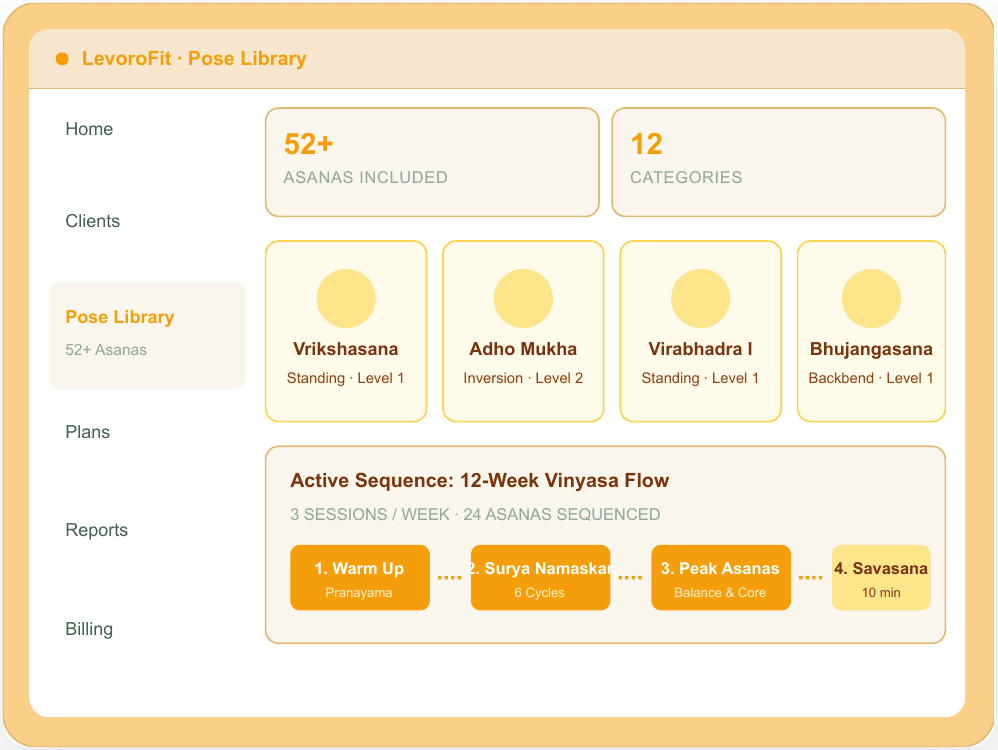
Planning your sessions. Keeping a record of the sequences you teach helps you build progressions over weeks and avoid repeating the same class. Many teachers use a notebook. A tool with a built-in pose library makes this faster, since you can build and save sequences from a catalogue of asanas rather than writing them out each time.
If you run both formats, keep them on one schedule so students can see every option in one place. Running online and offline batches from separate lists is one of the fastest ways to create confusion.
Tools for this stage: Zoom or Google Meet for online classes, basic audio and lighting gear, and a yoga instructor platform to publish one schedule, take bookings and cap batch sizes, so students reserve their spot without messaging you.
Step 5: How to Collect Payments and Handle GST
UPI has made collecting money easy. Tracking it has not. When forty students pay on different dates through GPay, PhonePe, bank transfer and cash, month-end turns into scrolling through screenshots and matching names to amounts.
Three practices keep this under control:
• Record every payment against a student and a plan, at the moment it arrives. "Ritu paid ₹4,800 for the October 12-class pack" is useful. A UPI notification with a nickname is not.
• Send a receipt or invoice every time. It looks professional and avoids disputes about what was paid for.
• Know who is due and overdue at any point, without having to work it out.
What about GST? Many solo teachers don't need to register for GST yet. For suppliers of services, registration becomes mandatory once aggregate annual turnover exceeds ₹20 lakh, or ₹10 lakh in Manipur, Mizoram, Nagaland and Tripura (CBIC). Aggregate turnover includes everything you earn from classes, packs, workshops and retreats. Below the threshold, you can bill without GST. If you're registered, or getting close, you'll need GST-compliant invoices showing your GSTIN and the correct tax. Rules can change, so confirm your position with a chartered accountant.
Tools for this stage: UPI apps for collection, and either a spreadsheet or a yoga instructor platform to record payments against each student's plan. If you are GST-registered, choose software that issues GST-compliant invoices itself. Levorofit has GST-native billing built in, so invoices sit alongside your student records and bookings rather than in a separate billing tool.
Step 6: How to Protect Your Income From Student Drop-Off
Retention is the single biggest lever in a solo yoga business. Finding a new student takes weeks of posts, conversations and trial classes. Keeping an existing one takes a timely message. A teacher with 40 students who stay for a year has a far more stable business than one with 80 who leave after two months.
Students rarely announce that they're leaving. They miss one class, then two, then their pack expires and they don't renew. The teachers who keep students longest notice the drift early and reach out personally: "Haven't seen you this week, is everything okay? Your knee feeling better?"
What helps students stay:
• Noticing absences early, ideally within a week or two of a student going quiet.
• Visible progress, such as a pose they couldn't do in month one, or a streak of classes attended.
• Something between classes, like a short daily practice, a breathing challenge or a note on what you covered.
• Small celebrations, such as class milestones, practice anniversaries and birthdays.
Tools for this stage: with a small group, your memory and a weekly look at your attendance sheet can be enough. With a larger group, attendance tracking in software makes drift visible. Levorofit goes a step further with at-risk student detection, which flags students whose attendance is dropping so you can reach out before they lapse. Its Daily Challenges and Session Highlights also keep students engaged between classes. For more ideas, see 27 Easy Ways to Keep Your Yoga Students Coming Back.
The Best Tools for Independent Yoga Teachers: Your Tool Stack at a Glance
Here is the full toolkit by stage. Free tools handle marketing and delivery well. The operations jobs, such as bookings, packs, payments and attendance, are where a dedicated yoga instructor platform saves the most time.
|
Stage |
Free or low-cost tools |
When to upgrade to a yoga instructor platform |
|
Define your offer |
Notebook, Google Docs |
Not needed |
|
Pricing and packages |
Google Sheets |
When you sell packs with expiry dates to 20+ students |
|
Finding students |
Google Business Profile, Instagram, WhatsApp Business, Canva |
When you want one booking link for trial classes |
|
Delivering classes |
Zoom or Google Meet, phone stand, mic, lighting |
When you run several batches or mix online and offline |
|
Getting paid |
UPI apps, bank transfer |
When you can't see who is due at a glance, or need GST invoices |
|
Keeping students |
Attendance sheet, personal WhatsApp messages |
When you can no longer spot who is drifting away |
Notice the pattern. Each free tool solves one job well, but none of them talk to each other. That gap is what an all-in-one platform closes. If you're weighing free tools against paid options in more detail, read Free Yoga Studio Software: Is It Worth It?
Why a Yoga Instructor Platform Ties It All Together
A yoga instructor platform is software that handles the operations side of your practice in one place: your schedule, bookings, packs and memberships, payments, attendance and student records. The value isn't any single feature. It's that every step is connected. A booking marks attendance, attendance updates the student's pack, and the pack's expiry triggers a renewal reminder. With separate tools, you are the one copying information from place to place.
When comparing software for independent yoga teachers, look for:
• Simplicity: you should be set up within a day, without technical help.
• Mobile-first use: both you and your students will mostly use a phone.
• Pricing that fits one person: not a plan built for a 10-teacher studio.
• Indian payment and billing support: UPI-friendly payment tracking and GST invoicing if you need it.
• Room to grow: the option to add a second teacher or workshops later without switching systems.
Levorofit: Software for Independent Yoga Teachers in India
Levorofit is a yoga instructor platform built for independent teachers and small studios, with India in mind. Beyond scheduling, bookings, memberships and payments, it includes features designed specifically for the way yoga teachers work:
• Pose Library to build and save class sequences from a catalogue of asanas.
• At-risk student detection to flag students whose attendance is dropping.
• Daily Challenges and Session Highlights to keep students engaged between classes.
• AI Assistant to surface patterns in your data and draft follow-up messages.
• Dosha-aligned nutrition plans to support students beyond the mat, based on Ayurvedic Vata, Pitta and Kapha principles.
• GST-native billing so invoices are created in the same place as bookings and payments.
You can explore the full feature set on the Levorofit yoga studio software page. To see how it compares with other options, read our comparison of 7 yoga studio management software platforms.
A Simple Weekly Routine for a Solo Yoga Business
Systems only work if you use them. This routine takes about an hour a week in total.
1. Monday (15 minutes): check the week's schedule and batch capacities, and post your timings on Instagram and WhatsApp.
2. After every class (1 minute): mark attendance straight away, while you remember who came.
3. Midweek (10 minutes): reply to enquiries and send your booking link to anyone interested in a trial.
4. Friday (20 minutes): check whose packs expire in the next 7 days, who has pending payments, and which regulars missed classes this week. Send a short, personal message to each.
5. Once a month (15 minutes): review attendance by batch, income by plan, and how many students renewed. Decide whether to add a batch, change a time slot or plan a workshop.
Common Mistakes Solo Yoga Teachers Make
• Teaching everyone, everything. A vague offer makes you easy to overlook. A clear niche makes you easy to recommend.
• Undercharging and relying on drop-ins. Packages give you stable income and give students a reason to keep showing up.
• Letting packs expire silently. A reminder a few days before expiry is the cheapest retention tool you have.
• Running the business from memory. Payments, renewals and attendance should be written down the moment they happen.
• Ignoring students who go quiet. By the time a student says they're leaving, they've usually already decided.
• Using too many disconnected apps. Every extra tool is another place to update and another chance to miss something.
• Waiting too long to get organised. The more students you have, the harder it is to move them to a new system. Setting up early is easier.
Frequently Asked Questions
How do I start a solo yoga business in India?
Start with a clear niche and a small core offer, such as two or three regular batches. Set up a Google Business Profile, an Instagram account and WhatsApp Business so students can find and contact you. Price in packs rather than drop-ins, and keep simple records of payments and attendance from day one.
What are the best tools for independent yoga teachers?
For marketing: Google Business Profile, Instagram, WhatsApp Business and Canva. For online classes: Zoom or Google Meet. For bookings, packs, payments, attendance and retention: a yoga instructor platform such as Levorofit, which keeps all of these connected in one place.
What is a yoga instructor platform?
A yoga instructor platform is software that lets an independent yoga teacher manage their schedule, bookings, class packs, payments, attendance and student records from one place, instead of spreadsheets and chat groups.
When do independent yoga teachers need software?
Usually once you teach several batches a week, sell packs with expiry dates, or have more than 20 or so regular students. Before that, free tools are often enough. Software for independent yoga teachers pays off when tracking renewals, payments and attendance by hand starts costing you hours or income.
How much should I charge for yoga classes as a solo teacher?
It depends on your city, experience, niche and format. Research what comparable teachers near you charge, set a drop-in rate, and offer packs and monthly plans at a modest per-class discount to encourage commitment.
Do solo yoga teachers in India need to register for GST?
Not always. Registration generally becomes mandatory once your aggregate annual turnover crosses ₹20 lakh for services (₹10 lakh in Manipur, Mizoram, Nagaland and Tripura). Thresholds and rules can change, so confirm your situation with a chartered accountant.
Can I run a solo yoga business without my own studio?
Yes. Many independent teachers in India teach in rented halls, society clubhouses, parks, students' homes or online. The business side stays the same wherever you teach: a clear offer, fair pricing, an easy way to book and pay, and accurate attendance records.
Do I need a certification to teach yoga in India?
Certification from the Ministry of Ayush's Yoga Certification Board (YCB) is voluntary, not mandatory. Even so, a recognised certificate from YCB or a Yoga Alliance registered school builds trust with new students, so display it clearly.
How many students does a solo yoga teacher need for a full-time income?
It depends on your price and income goal. As an illustration, 25 regular students on a ₹4,800 monthly pack bring in ₹1.2 lakh a month. Keeping those students for 12 months matters more than constantly adding new ones.
Final Thoughts
A successful solo yoga business isn't built on more hours of admin. It's built on a clear offer, fair and predictable pricing, a steady way for students to find you, reliable classes, effortless payments, and genuine care for the students you already have.
Free tools will carry you a long way, especially for marketing. When the operations side starts to crowd out your teaching, a yoga instructor platform gives you back that time, so your evenings go to rest and preparation instead of reconciling UPI screenshots.
For broader growth strategies such as corporate tie-ups, retreats and new revenue streams, see 25 Ways for Managing and Building a Profitable Yoga Business.
Ready to spend less time on admin and more time teaching?
Start your 14-day free trial → No credit card required.
Book a demo → See scheduling, billing and student management on a real workspace with our team.
Explore Levorofit's plans to find the setup that fits your practice.
Sources
• GST: An Update (May 2019), Central Board of Indirect Taxes and Customs: GST registration thresholds for suppliers of services.
• About Yoga Certification Board, Yoga Certification Board, Ministry of Ayush.
• Yoga Certification Board FAQs, Yoga Certification Board: voluntary nature of certification.
⏳ Update History
Last edited by Blog Admin
"Updated via admin form"
Vinay Jindal
Fitness • Health & wellness • Nutrition
Vinay Jindal is a wellness content intern at Levorofit with a keen interest in healthcare technology, digital wellness, nutrition, and preventive health. He enjoys researching how emerging technologies like artificial intelligence are improving healthcare accessibility, patient engagement, and overall well-being. Through his writing, he aims to make complex health and technology topics easier for readers to understand. He enjoys exploring the latest developments in nutrition, fitness, recovery, healthy habits, and digital health to create informative content that empowers individuals to make smarter lifestyle choices. At LevoroFit, Prince contributes educational content that helps fitness professionals, nutrition coaches, and health-conscious individuals stay informed about evolving trends in health, wellness, and nutrition.